
Ended
Skuja Braden (Ingūna Skuja & Melissa D. Braden)
Selling Water by the River
Apr 14 – Nov 27, 2022
The exhibition Selling Water by the River (Latvian: Tirgot ūdeni upes malā), created by the internationally acclaimed artist duo Skuja Braden and curators Solvita Krese and Andra Silapētere, reflects upon the possibility for getting along in a world torn apart by dispute, and proposes a vision of an inclusive society, receptive to diversity.
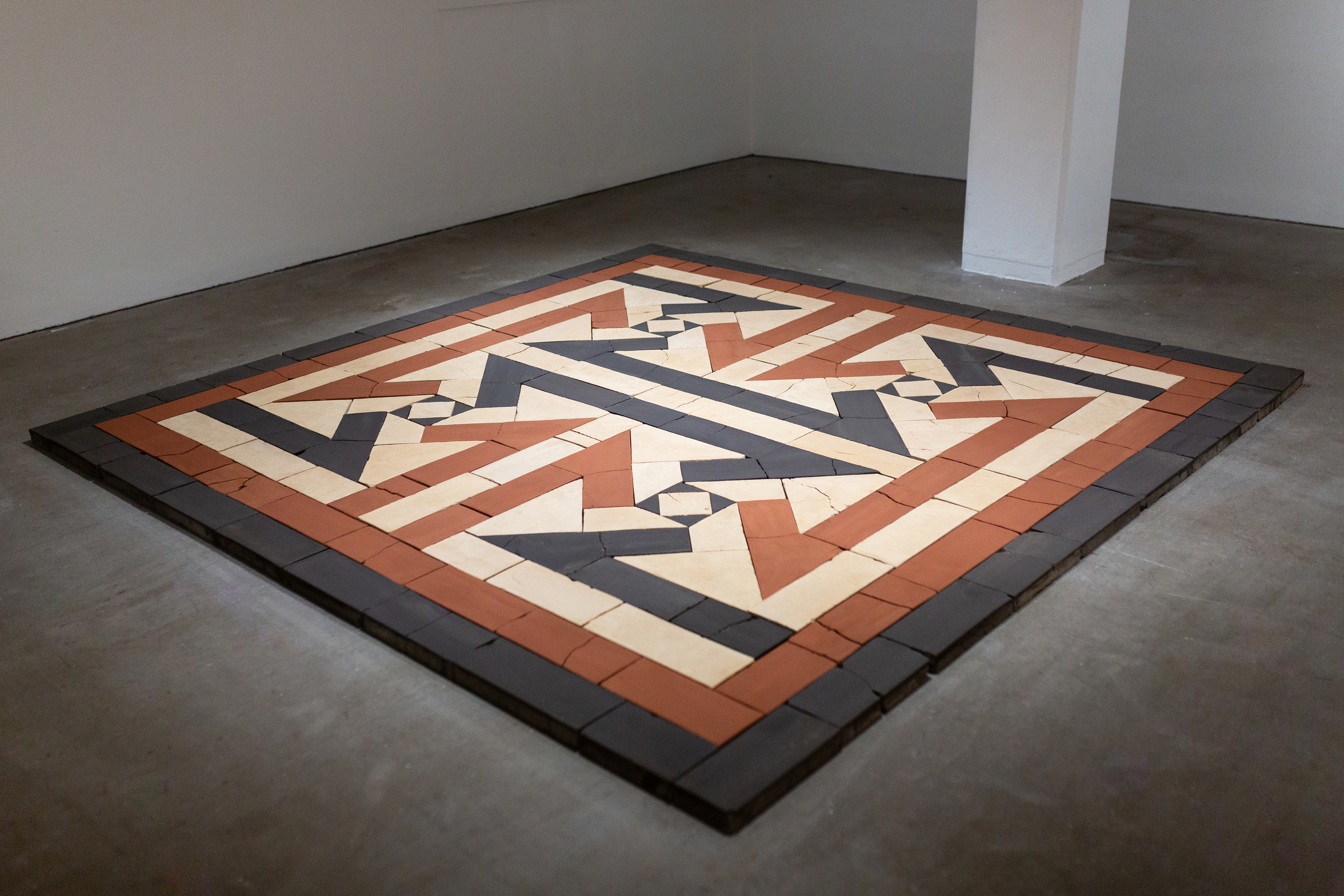
Skuja Braden’s exhibition features a massive multimedia installation, comprising more than 300 porcelain works, the smallest the size of an eyeball and the largest weighing in at one ton. Social, economic, political and cultural themes are echoed in these masterfully crafted objects, which, in a most unusual manner, assume the shapes of everyday items, elements of nature and human bodies.
“The show’s architectural structure is defined in reference to the artists’ life space, that is, their home and the different areas of cohabitation therein. Skuja Braden’s oeuvre, with its grotesque imagery, dissolves the boundary between private and public and reflects upon different social norms. Concurrently, the architecture of the show also serves as a metaphor for an uneasy getting-along in a world torn apart by disagreement and change, a world that all of us inhabit today,” say Pavilion curators Andra Silapētere and Solvita Krese.
At its core, the message of the Latvian Pavilion Selling Water by the River is that we have already been given all that we need. In this idea, inspired by Zen Buddhism, the artists see a possibility for an inclusive society, receptive to diversity, which the water referred to in the exhibition title comes to symbolize. Water is an element that links all living beings, and it’s the source of life as such. Describing the Pavilion, curators Solvita Krese and Andra Silapētere note the following: “Water flows through and past any differences. It envelops and connects, urging one to think about care and accepting otherness. Just as in the Zen master’s koan about selling water by the river, water teaches us to recognize that we already have everything that we need; we only have to learn to see it.”
In order to highlight the baroque beauty of Skuja Braden’s porcelain works, the Pavilion architect Līva Kreislere has opted for a restrained architectural solution, in terms of both form and color. In an affirmation of the message of the show, which encourages responsible consumption, the Pavilion installation is built with sustainable and innovative materials, namely Riga Wood birch plywood and the new Riga ECOlogical glue, produced by Latvijas finieris, a supporter of the Latvian Pavilion. Paint for the finish is provided by the Latvian branch of the Tikkurila company.
Skuja Braden is an artistic collaboration, born in 1999, between Ingūna Skuja from Latvia and Melissa Braden from California. Their work is a fusion of decorative styles, touching on literary and art historical themes, grounded in the politics of now, and interpreted entirely through the experience of their shared existence, which expresses itself stylistically as Cartoon Realism in porcelain.
Their solo exhibitions have been held at the Decorative Art and Design Museum in Riga, the Contemporary Craft Museum in Oregon, and the John Natsoulas Gallery in California. The duo has participated in numerous group exhibitions, the latest being held at Whitechapel Gallery in London as well as art fairs, including SOFA-Chicago; Ceramic Annual of America, San Francisco; Start Art Fair; Saatchi’s Gallery, London; and Scope Art Fair Basel. Skuja Braden’s works have been published in Contemporary Studio Porcelain, A Human Impulse, and the Lark Books 500 series on Ceramics. They have also been featured in Ceramic Monthly, New Ceramics, and Curve Magazine. Their works appear in public and private collections including the White Memorial Medical Center in L.A., the Kellogg Art Collection in Pomona, the Museum of Contemporary Ceramics in Santo Domingo, Latvian National Museum of Art, Museé Ariana in Switzerland, World Ceramic Center in South Korea, Changchun Ceramic Center in China, ASU Art Museum in USA, Westerwald Keramike Museum in Germany, and Zuzeum in Latvia.
The Pavilion at the 59th Venice Biennale is the work of two experienced curators Andra Silapētere and Solvita Krese (LLMC), producer Kitija Vasiļjeva, architect Līva Kreislere, graphic designer Rūta Jumīte, designers Aleksejs Beļeckis and Pauls Jēgers, and the communications team of Copywriter/Levelup (Olga Procevska, Igors Gubenko, Jekaterina Firfjane) and Sofija Anna Kozlova (LLMC).
Supported by the Ministry of Culture of the Latvian Republic, Jānis Zuzāns, and SIA Alfor, as well as AS Latvijas finieris and SIA Tikkurila.
Commissioner: Solvita Krese
Curators: Solvita Krese and Andra Silapētere