Ended Mar 16
Olivier Millagou
A Swingin' Summer
Jan 31 – Mar 16, 2019
More from Olivier Millagou on Gallop
It is necessary to imagine that the wall on which the surfers line up on a beach in Malibu or elsewhere compose and recompose a set of stories and shapes with each new sliding session. There are many possible stories. There are also famous walls in the history of surfing. The one on which Miki Dora, known as Da-Cat, signified her authority in the 1960s in a tag, «Da-Cat Rules», is one of them. Between the surfboards planted in the sand and the «Locals only» displayed on the walls, there was a question of territories, a certain form of outrageous virility and exclusivity of landscapes.
The exhibition A Swingin’ Summer, which, like all Olivier Millagou’s exhibitions, takes its title from a surf movie, takes as its origin this vertical plane facing the sea and which carries against it the expression of this vital need for the horizon. To think of an exhibition as a beach wall is to place the viewer on the ocean side in the middle of the swell, ankles licked by the foam of the waves. Above all, it means much more than an attachment or commitment, a way of being and looking at the world. The beach as an omnipresence, as a natural environment, an eco-system from which an artistic production can be extracted. So each of the works on display owes its origin to this strip of coastline. Sculptures moulded directly into the sand, beach drawings, painted and sun-exposed road signs, and of course totem boards ready for travel... everything is extracted and aligned frontward in front of (or on) a painted wall.
In A Swingin’ Summer, you can see it from East to West. The exhibition is a sequence that makes up a rainbow. An exhibition born from a summer rain. The chromatic scales are intertwined from red, orange, yellow, yellow, green, blue to purple. And the sound of an orchestra composed of the sea, a few boards, wind and sand, diffuses into space the breath of what we could rightly take for the mother of all surf music. The stage is set.
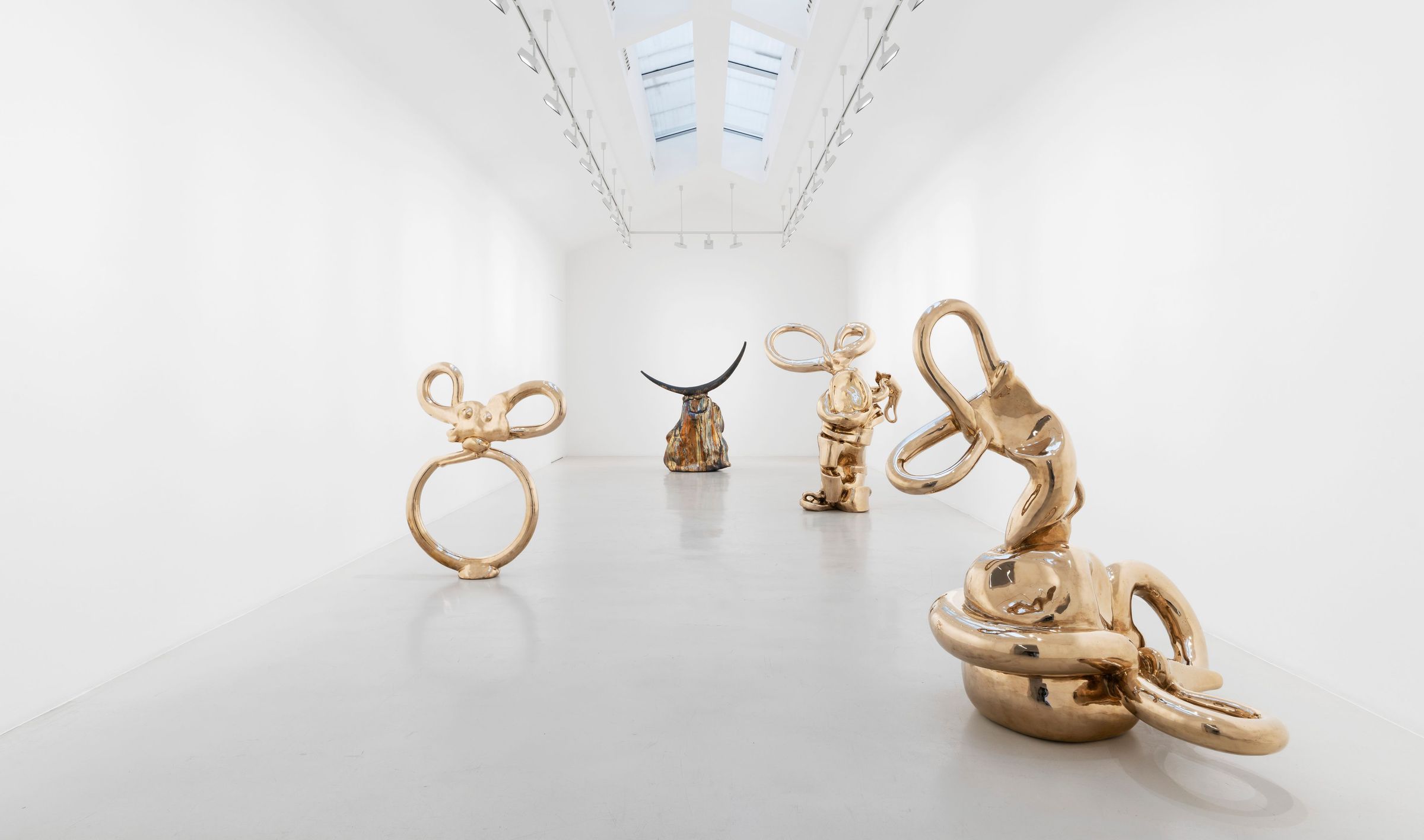
Peter is a large pink and red sculpture, it lives in this space, it is the most imposing of the three surfable sculptures. It is distin- guished by its size, by the superposition of its Polynesian deities motifs, as well as by its evocative shape which seems to have something to prove. If it was possible that the expression of virility could still be seen in surfing codes today, we think that Peter could probably testify to it. But it is Peter Drouyn whom Olivier Millagou summons, one of the most respected surfers, the model of a generation, and who in 2012 changed sex to Westerly Windina during a trip to Thailand. Here as elsewhere, there are worlds that stand on the fall of elders.
All the surfable sculptures are made from materials (bio-foam, linen fibre, organic sourced resin...) and techniques (channel, finless, rockers, tails...) derived from shaper [1] know-how. However, their nature is thwarted by the desire to shift the question of their performance to the formal rendering side. Irregular, disproportionate, even asymmetrical, they stand upright, face each other and despite their glaring handicap seem to be waiting for us to finally decide to throw ourselves into the water, belly flat.
Facing the wall of A Swingin’ Summer, a community is gathered. Peter (Drouyn), Miki (Dora) or Rob (Machado), cross strange figures, a mixture of tikis [2] and cartoon, pinned as we show the ancestral statuettes of distant cultures in museums. Moulded in the sand of a beach, they would have the power to make the right waves happen. Pray for the possibility of a tube. Sheep Janis Joplin, lemur Kurt Cobain, horse Lee Hazlewood, are also part of the celebration (and the tubes happen). Coarsely painted on traffic signs, they make sure that nothing really becomes normal. For Olivier Millagou, they are the hallucinated apparitions of a wild world, a hippie vision in which hairpieces are worth all identities. We are on a territory of beliefs, a playground where stating things is like making them real.
At sunset, a sign confirms what we had felt in the moment, it is above all a question of pleasure. Announcing «La maison du jouir», the sign evokes Gauguin’s last residence in the Marquesas Islands. On his foundations the painter had not felt the need to tag his authority but had written on it the motto of what he considered to be a precept of happiness: «Be in love and you will be happy».
Thinking of an exhibition as a beach wall allows you to build stories, dig tunnels and gather your own. A Swingin’ Summer, is Olivier Millagou’s fourth monographic exhibition at Sultana Gallery, bringing together a heterogeneous, hedonistic and solar community.
- Guillaume Mansart
1 - The shaper is the craftsman who makes surfboards.
2 - Tikis are small Polynesian sculptures representing half human, half divine characters.