
Ended
Pedro Neves Marques
Vampires in Space
Apr 20 – Nov 27, 2022
2nd Piano Nobile
In space, it’s always night.
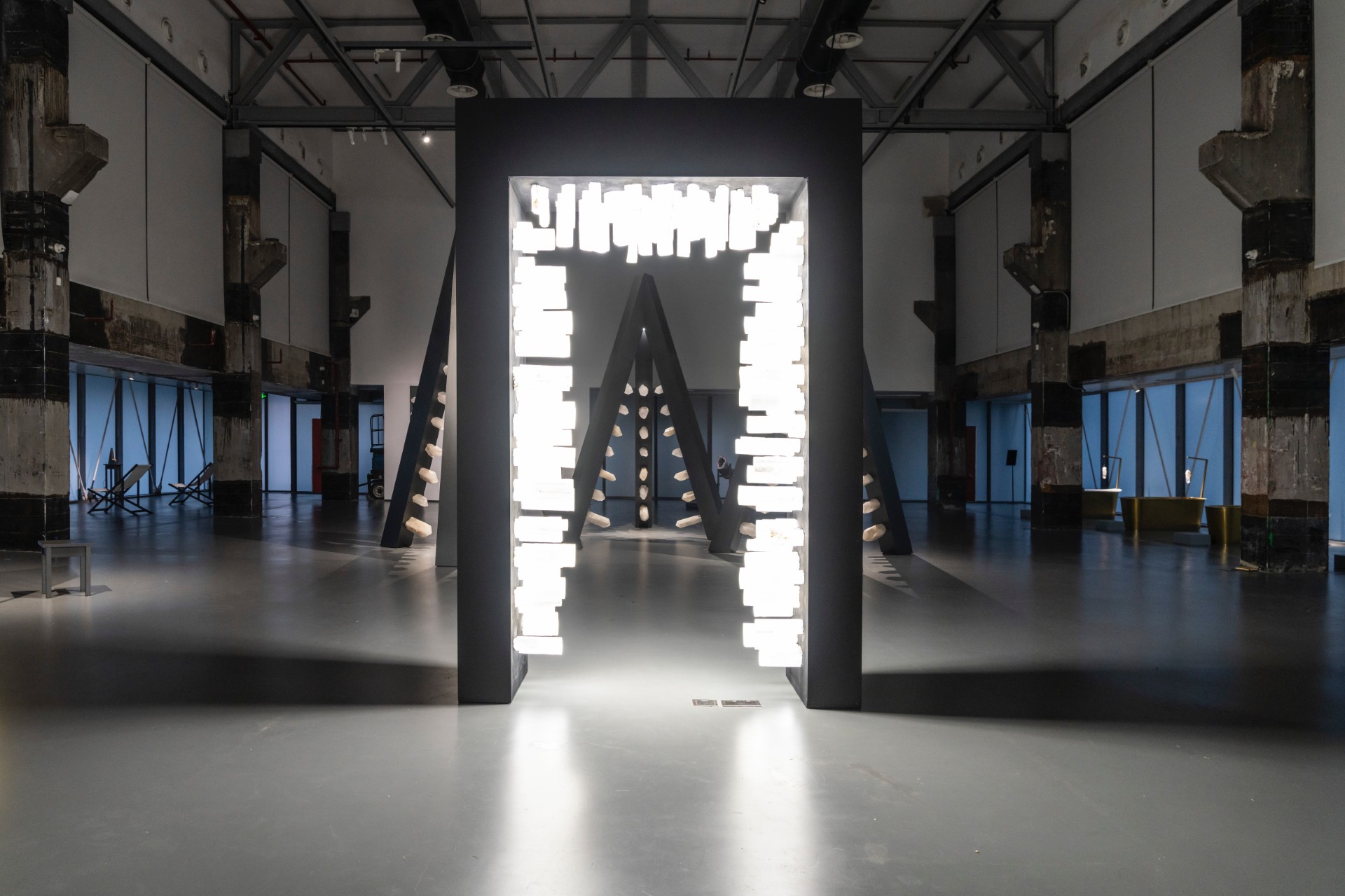
Vampires in Space, by Pedro Neves Marques, Official Portuguese Representation at the 59th International Art Exhibition – La Biennale di Venezia and curated by João Mourão and Luís Silva, is a narrative installation that transforms, in part, the Gothic architecture of Palazzo Franchetti into an unexpected spaceship, within which the wistful existence, dramas and routines of five passengers unfold during a long, centuries-long journey to a faraway planet.
Through a new film, unpublished poetry and an immersive exhibition design, Pedro Neves Marques resorts to the figure and expectations of what we consider to be a “vampire” to address issues of gender identity, non-nuclear families, queer reproduction, and also the role of intimacy and mental health today. The vampire’s imagined longevity, reinforced here by the physical distance from planet Earth and the notion of humanity, allows for a retrospective exercise that could be called “scientific autofiction”, anchored in Neves Marques’s own non-binary trans experience, as well as a political review of an extensive history of control over bodies and desire. If vampires have always reflected period debates on gender, from the Victorian era to feminist liberation and the AIDS crisis, how do they answer today to advances in biotechnology or the emancipation of queer lives and ecologies?
After all, in space it is always night and, in their immortality, vampires are the perfect beings to deal with the incommensurability of spatial distances.
—
The Official Portuguese Representation at the 59th International Art Exhibition of La Biennale di Venezia presents a solo project by Pedro Neves Marques, one of the most relevant and celebrated artists of their generation.
Neves Marques’s practice, which spans visual arts, cinema, poetry and theory has established a brand of speculative fiction that deals with some of the most prescient issues of our time, from ecology to body politics. Neves Marques understands the tropes of the sci-fi genre in a manner that enables them to question the dystopian futures that loom over our heads, giving us a glimpse of parallel, critical ways of being in the world.
Titled Vampires in Space, Neves Marques’ project for the Portugal Pavilion takes the form of a narrative installation, comprising film, confessional poetry and scenography, designed by Diogo Passarinho Studio, that transforms the second floor of Palazzo Franchetti into an unexpected spaceship, within which the wistful existence, dramas and routines of its five passengers unfold during a centuries-long trip to a distant planet. The immersive scenography contrasts the Gothic Venetian style of the palace with a sci-fi and speculative sensibility, typical of the artist’s’ ongoing practice.
The straightforwardness of the title is intentional and allows the narrative to unfold unburden by world building. In a way, the title says it all. The film offers a glimpse into the life of five vampires as they travel through space, carrying life to a faraway Earth-like planet. After all, in space it is always night and, having eternity at their disposal, vampires are the ideal candidates to roam the stars. In their solitude, away from societal constraints and expectations, this family of vampires recalls and reimagines their past lives, guiding the visitor through an open-ended narrative about the role of fiction in our lives, and in particular in lives marked by gender dysphoria or transgender experiences.
Vampires is Space presents itself as a tale with no beginning nor end, in which what matters is the journey and not the destination. Emma, the youngest vampire on board, is afflicted by amnesia, only remembering their past lovers’ scents and touch, never their names or faces, and finds solace in the comic books of her youth. Selena is a transgender person of many lives, whose only wish is for this family to simply hold on a little longer. Itá, who had once been the commander of the mission can now barely find the strength to leave her bed, while Alex is about to discover the true meaning of vampirism. Lorna, a cis woman who wished to live forever and for that reason was turned a vampire just before the mission launched, is now in charge of the mission.
Vampires in Space thus resorts to the figure and expectations of what we consider a “vampire” in order to address issues of gender identity, non-nuclear families, queer reproduction, as well as the role of intimacy and mental health today. The vampire’s imagined longevity, reinforced here by a physical distance from planet Earth and the notion of humanity, allows for a retrospective exercise in what could be called a “science autofiction” anchored in Neves Marques’ own gender experience, as well as a political critique of an extensive history of control over bodies, desire and imagination. If vampires have always reflected epochal debates on gender, from the Victorian era to feminist emancipation and the AIDS crisis, how do they respond to contemporary biotechnology or the emancipation of queer lives and ecologies?
Vampires in Space is, as all of Neves Marques’s work, built on an equilibrium between forthright socio-political critique, an uncommon storytelling speculation, and the creative and emotional place of personal exposure, invoking a space of intellectual and poetic freedom for art.
—João Mourão & Luís Silva
—
Pedro Neves Marques (Lisbon, 1984, they/them) is a visual artist, film director and writer. Over the last fifteen years they have lived in London, São Paulo and New York and held solo exhibitions in institutions such as Galerias Municipais – Cordoaria Nacional (Lisbon), CA2M Centro de Arte Dos de Mayo (Madrid), CaixaForum (Barcelona), 1646 (The Hague), High Line (New York), Castello di Rivoli (Turin), Gasworks (London), Pérez Art Museum Miami, Museu Colecção Berardo (Lisbon) and e-flux (New York). Their work has been featured in numerous biennials, including Liverpool Biennial, Gwangju Biennale, Göteborg International Biennial, Guangzhou Image Triennial, New Museum Triennial, Ural Biennial for Contemporary Art, Contour Biennial and Cuenca International Biennial. Recent group exhibitions and screenings in which they have participated include Trondheim Kunsthall, PinchukArtCentre (Kiev), Inside Out Art Museum (Beijing), Antenna Space Gallery (Shanghai), Le Fresnoy (Tourcoing), Matadero (Madrid), Harn Museum of Art – University of Florida, MAAT (Lisbon), Parco Arte Vivente (Turin), Fundacíon Botín (Santander), Kadist (Paris), Tate Modern Film (London), Serpentine Galleries Cinema (London) and Guangdong Times Museum (Guangzhou). Their films have been shown at film festivals such as Toronto International Film Festival and New York Film Festival, received awards at festivals such as MixBrasil (São Paulo), Go Shorts (Nijmegen), Short Waves (Poznan), Sicilia Queer Film Festival and Moscow International Experimental Film Festival, and been nominated for the European Film Awards. Together with Alice dos Reis, Neves Marques co-founded the poetry publishing house Livros do Pântano / Pântano Books, with which they published the poetry book Sex as Care and Other Viral Poems (2020) and translated the work of the North American poet CAConrad into Portuguese. Neves Marques is the author of the short story book Morrer na América [Dying in America] (Abysmo and Kunsthalle Lissabon, 2017) and edited the anthologies YWY, Searching for a Character Between Future Worlds: Gender, Ecology, Science Fiction (Sternberg Press, 2021) and The Forest and The School (Archive Books, 2015). They also co-edited a special issue of the art and theory journal e-flux journal for the 65th Venice Biennale (2015). The work of Pedro Neves Marques received the “Present Future Art Prize” at Artissima in 2018 and the “Special Prize” of the PinchunkArtCentre Future Generation Art Prize 2021. They recently premièred Becoming Male in the Middle Ages (2022) at the Ammodo Tiger Short Competition at the International Film Festival Rotterdam (IFFR), for which they received the prestigious Ammodo Tiger Short Award, and which was nominated by IFFR Pro at the European Film Awards for short films. Their artistic work is represented by Galleria Umberto di Marino (Naples) and their films are distributed by Portugal Film and Agência da Curta Metragem.
João Mourão (Alegrete, 1975) is currently director of Arquipélago – Contemporary Arts Centre in the Azores and was previously the director of the Galerias Municipais de Lisboa. In 2009, in partnership with Luís Silva, he founded the Kunsthalle Lissabon, which he co-directed until 2020. Mourão and Silva curated the Drawing section at Artissima (Turin), solo projects at Zona Maco Sur (Mexico City), solo projects at Arte BA (Buenos Aires), and the Performance section at Art Dubai. The duo has also curated exhibitions in institutions such as MAAT (Lisbon), Fundação Arpad-Szenes Viera da Silva (Lisbon), MACE (Elvas), David Roberts Art Foundation (London), Fondazione Giuliani (Rome), Pivô (São Paulo), Institute for Contemporary Art (Philadelphia), Extra City (Antwerp). Also with Silva, he was contributing editor of CURA magazine, and his texts have been published in Artreview, Kaleidoscope and Contemporânea. The duo has been invited to debates regarding institutional models in London, New York, Cairo, Oslo and Beirut, and they have made nominations for the Pinchuk Art Prize, Kiev and Venice; the Nasher Prize, Dallas; and for the Battaglia Sculpture Prize, Milan. He was a member of the Gulbenkian acquisitions committee and a member of the EDP awards judging panel.
Luís Silva (Lisbon, 1978) is Director of Kunsthalle Lissabon, which he founded with João Mourão in 2009, and where they presented projects by renowned artists such as Sheroanawe Hakihiiwe, Laure Prouvost, Naufus Ramírez-Figueroa, Nathalie Du Pasquier, Petrit Halilaj, Mariana Castillo Deball, Haris Epaminonda, Jonathas de Andrade, Amalia Pica, Leonor Antunes and André Guedes. Together with Mourão, he has curated numerous exhibitions both in Portugal and abroad, including Manuel Solano (Pivô, São Paulo), Eduardo Batarda (Fundação Arpad Szenes Vieira da Silva), Ângela Ferreira (Galeria Pelaires, Mallorca), Carla Filipe (MAAT), Pedro Barateiro (Basement Roma), and group exhibitions in institutions such as MACE (Elvas), David Roberts Art Foundation (London), Fondazione Giuliani (Rome), and Extra City (Antwerp). The duo curated Zona Maco Sur (Mexico City), the Drawing section of Artissima (Turin), the solo projects section of Arte BA (Buenos Aires), and the performance section at Art Dubai. He was editor of CURA magazine and co-editor of the Performing the Institution(al) series. He has edited monographs by artists such as André Guedes, Pedro Barateiro, Naufus Ramírez-Figueroa (in collaboration with the New Museum) and Haris Epaminonda and Daniel G. Cramer. He recently curated a solo exhibition by Pedro Neves Marques at the Galerias Municipais – Cordoaria Nacional (Lisbon).