Opens tomorrow
Karl Horst Hödicke
Bilder Aus Dem Dessauer Turm
Nov 12, 2026 – Jan 21, 2027
Opens Nov 12, closes Jan 21. Get a reminder before it closes.
 or scan for the iPhone app
More from Karl Horst Hödicke on Gallop
The Vault
König Galerie is pleased to present the exhibition Bilder Aus Dem Dessauer Turm by Karl Horst Hödicke in the Vault at St. Agnes. This is the artist’s seventh exhibition at the gallery.
The exhibition title refers to the nickname Hödicke once gave to the building on Dessauer Straße in Berlin, where he lived and worked for decades. Located near Potsdamer Platz, close to the Wall, it was for a long time the only remaining building in the area, standing like a tower amid an otherwise desolate urban landscape.
It was here that Hödicke created the portraits of Berlin for which he is best known: paintings of the city’s nightlife, with its dazzling characters and glowing neon signs, its ever-present construction sites and iconic buildings. Few artists have captured Berlin, with its scars as well as its unmistakable vitality, through a visual language as distinctive as Hödicke’s.
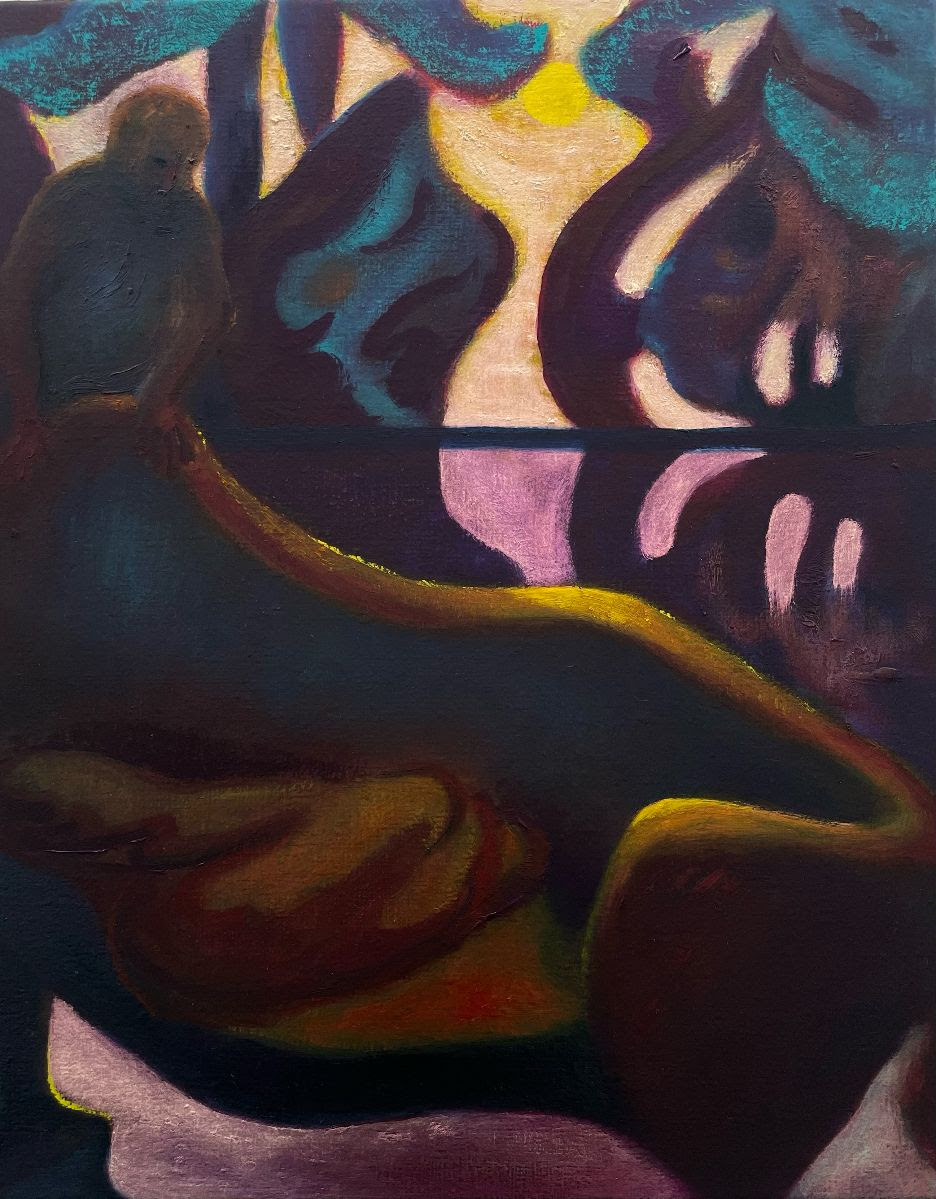
The exhibition in the Vault now focuses on paintings that turn the viewer’s gaze toward the interior life of the “tower”. These works also reflect Hödicke’s approach to painting, which he once described as depicting everything that came “right under his nose”. With this statement, he underscored his rejection of postwar abstraction, a stance that ultimately established him as one of the most significant and pioneering artists of the New Figuration movement in Germany. He wanted to bring real life, often mundane and unfiltered, onto the canvas. As a result, he found subjects worthy of painting not only in the city but also in his domestic surroundings, with his family, and while traveling. These subjects hold an equally important place in his oeuvre. He scoured his surroundings for motifs and portrayed the world radically as he saw it in everyday life. As such, the exhibition includes paintings from the 2001 series “Küche und Klo”, in which the subject matter could hardly be more ordinary or mundane: a collander and a fried egg are depicted in bold colors. These works convey a humorous sense of lightness and affection for the everyday.
The exhibition also features floral paintings, including yellow tulips against a black background, a motif Hödicke explored in several versions throughout his career. Here, the painter also engages with purely painterly concerns, such as the contrast between black and yellow.
Hödicke was an extraordinarily prolific painter. He worked quickly and in order to make this pace of creation possible financially, particularly at the beginning of his career, he initially used homemade binder paints instead of oil paints, later turning to commercially available acrylic and polyester resin paints from hardware stores. This approach is also evident in his brushwork, which is expressive and energetic. His paintings radiate a powerful sense of vitality and force.
A work that illustrates this particularly well is “der Sohn des Artisten + der Elvira (für Elvira)“. The large-format painting is rendered in a limited palette of warm orange and brown tones. Part of the canvas has been left white, revealing running paint and splatters. The painting depicts a woman lying on her back, balancing her child on the soles of her feet, which are raised in the air. The title tells us that the figures are Hödicke’s wife, Elvira, and their son, Jonas. The baby looks out of the painting toward the viewer, or toward the painter, his father. With rapid brushstrokes, the painting captures this fleeting, intimate, and playful moment.
The same motif appears several times throughout Hödicke’s oeuvre, including in his sculptures. A small bronze example is also included in the exhibition.
A third medium represented in the exhibition is gouache. This body of work is extensive and was the subject of a retrospective exhibition organized by the Staatliche Graphische Sammlungen in Munich in 2020, followed by an exhibition at the Palais Populaire in Berlin.
Karl Horst Hödicke (1938–2024) was a contemporary German artist known for his Neo-Expressionist paintings. The artist’s broad brushstrokes and specific colour palette provide his works with a sense of seeing a place through memory – specifically Berlin with its ever-changing cityscape was a central motif in his work. Having moved to Berlin in 1957, Hödicke became one of the spokespeople for a small group of impetuous young lateral thinkers who wanted to revolutionise painting. No sooner had German post-war modernism rejoined the international artistic trend towards the abstract than they revolted against this new doctrine with a revival of figurative painting, which had been declared obsolete. Hödicke was subsequently a pioneer of German Neo-Expressionism and New Figuration with Georg Baselitz, Jörg Immendorf, and A.R. Penck. He was one of the main protagonists and drivers of the New Savages or Junge Wilde movement in 1978, which arose in the German-speaking world in opposition to established minimal and conceptual strategies.
Currently works by K.H. Hödicke and Jonas Hödicke are on display at Werkstattgalerie Hermann Noack in Berlin. In 2023, a solo exhibition was shown at König Telegraphenamt in Berlin, Germany. The Staatliche Graphische Sammlung in Munich organized a retrospective of Hödicke’s works, which in 2020 traveled to Palais Populaire in Berlin. The exhibition was accompanied by a comprehensive publication in 2 volumes. Hödicke’s works were part of group exhibitions at institutions like Kunstmuseum Bonn, Bonn, Germany (2022 and 2018); Hamburger Kunsthalle, Hamburg, Germany (2022), Kunsthalle Emden, Emden, Germany (2021 and 2015); Kunsthalle Helsinki, Helsinki, Finland (2020); Museum Brandhorst, Munich, Germany (2020); Kunstmuseum Luzern, Luzern, Switzerland (2018); Art Gallery of New South Wales, Sydney, Australia (2016); Schirn Kunsthalle, Frankfurt am Main, Germany (2014) and others.