
Ended
Joaquín Boz
Fluid Boundaries
Apr 4 – May 25, 2024
Abstract art can manifest in numerous ways, being deductive or expressive, lyrical or rational, geometric or organic, as well as smooth or rich in gestures. In the realm of painting, abstraction acquires a unique expression when it is grounded in a well-defined ontology. Although painting does not speak, it creates speech. Joaquín Boz’s work is an example of how abstraction not only encompasses but also delves into complex concepts such as contingency and sensibility, through its meticulous layers of color.
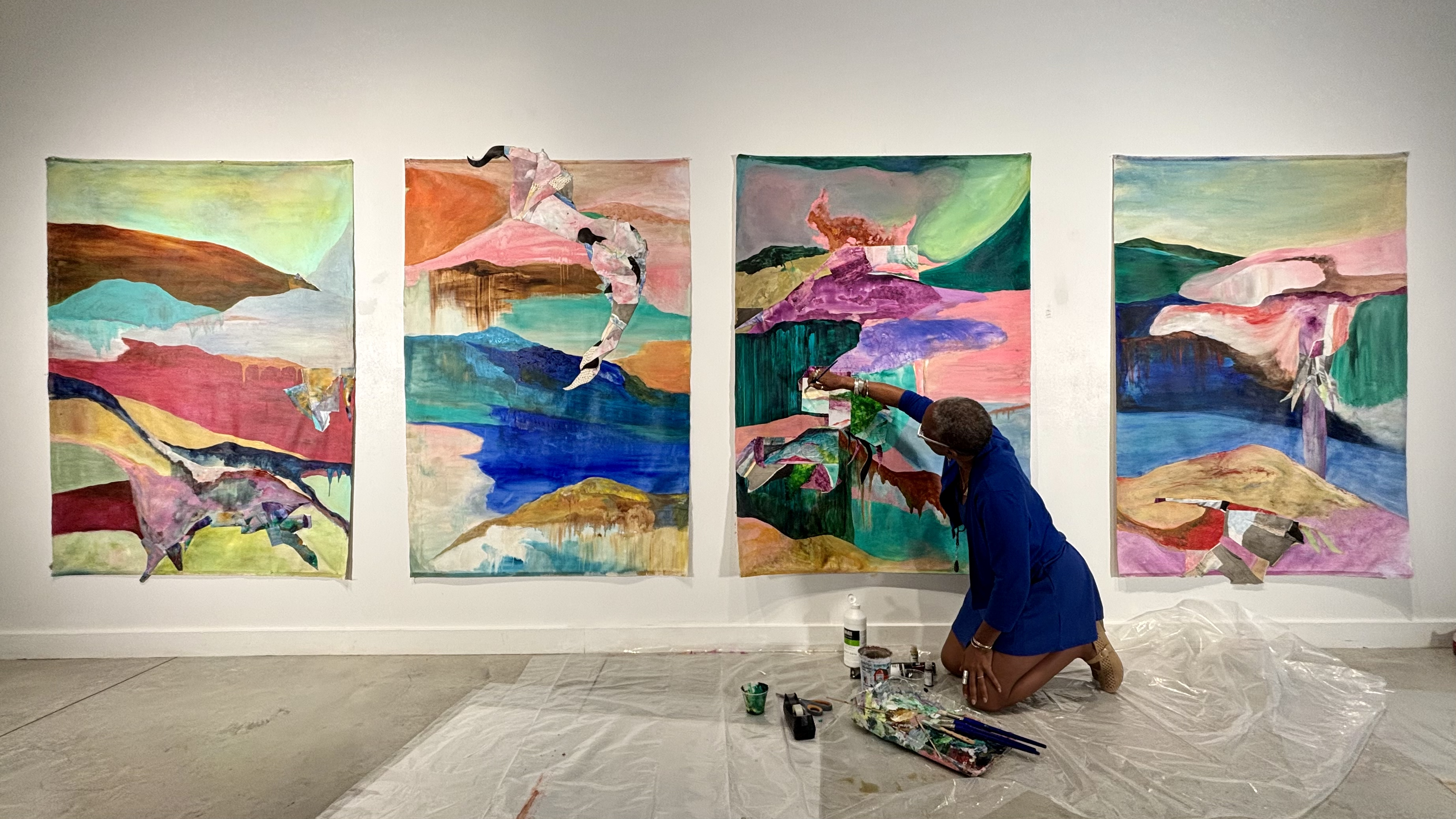
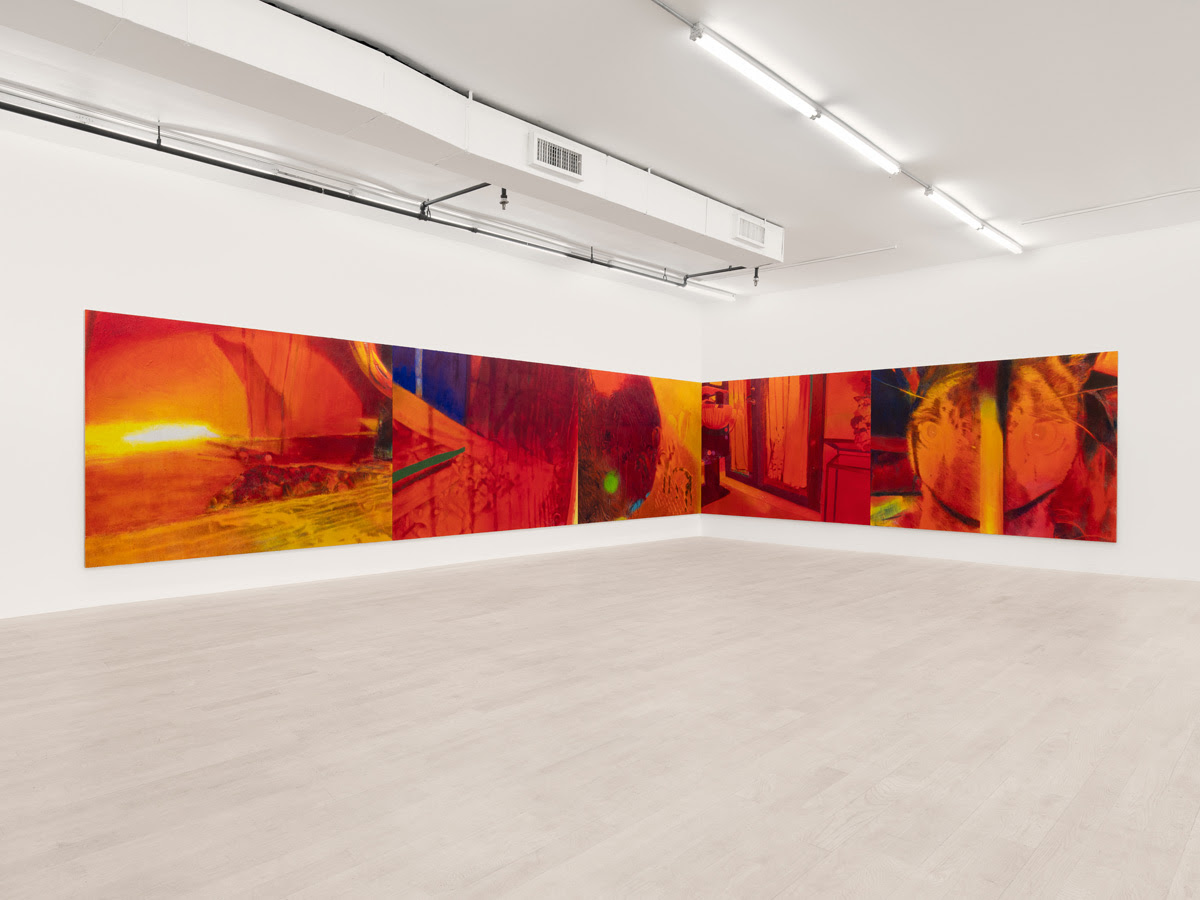
Contingency, understood as the possibility that any event may occur in a universe of uncertainty, is manifested in Boz's work as a guiding principle. Far from being limited to meaningless randomness, his approach to contingency is deeply intuitive, allowing uncertainty and chance to play crucial roles in the creative process. This approach not only demonstrates an acceptance of unpredictability but also celebrates the richness and diversity of possibilities that this can generate on canvas or wood. Each spatula application, every layer of color applied with the brush, a rag, his nails or his hands, reflects a decision made on the edge of the unforeseen, where the artist's intuition and sensibility expose the material's agency.
Matter whispers its path, tracing routes where its will unfolds. In his approach, contingency manifests in the freedom with which Boz allows the composition to reveal itself, a freedom that is testimony to a higher order, where chaos gives way to an emerging form of beauty and coherence. Looking at the artworks, one feels a pulse, a vibration of colors that mix and collide in bright layers, but also coexist harmoniously. By the twists of fate, oil, or the artist, shapes arise as echoes among the chaos, forms we believe we can decipher, awakening a search among memory’s folds for images and sensations with a relative independence from language.
Just as cognitive structures and artificial intelligences can navigate and manipulate a world inherently contingent, seeking ways to reconfigure reality and its possibilities, Boz's abstract painting similarly operates on the pictorial image, manipulating a gestural painting expression.
Sensibility, on the other hand, is revealed in how Boz organizes and makes sense of this contingency. In his world, sensibility is not merely an emotional or aesthetic reaction, it is a tool for navigating and ordering chaos. An order that reveals itself as harmoniously chaotic. Through his works, Boz invites us to experience sensibility as a faculty that transcends the purely personal, becoming a mechanism through which the world can be ordered and understood in a painting.
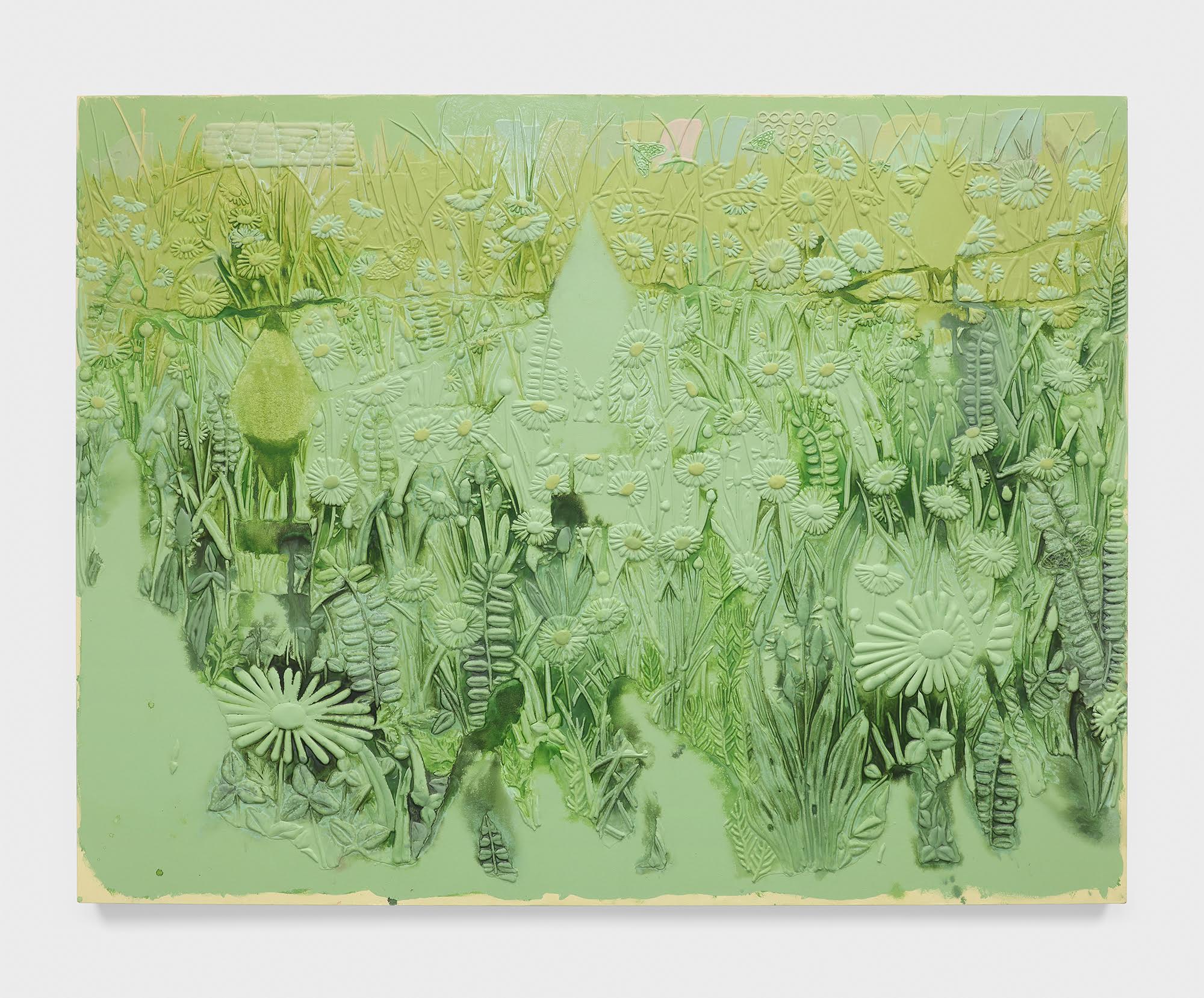
Boz's sensitivity extends beyond the visual, incorporating the tactile through the texture and materiality of his paintings. This tactile-visual approach reveals that the gaze is guided by touch, which acts as the central hub of all human perception senses. Is there anything deeper than the skin? How does a caress become the threshold between the material and the spiritual? The layers of colors in Boz's paintings manifest as the painting's skin. In Boz's paintings, there is a tactile drive in the materials, a longing for volume within abstraction. These works probe into the tactile anatomy of painting, where oil is revealed through contact, the crackling and expansion, perpetually oscillating between balance and imbalance.
A concept that emerges with force from Boz's work is "pictorial transmission." In the structure of the artwork, a mechanism of transmission is revealed where internal movement and transformation are evidenced through changes in form, sense, and texture. Each stroke, each layer of color, and each movement become vectors of internal transfer, weaving a surface where energy, intuition, and contemplation merge and manifest at the very heart of the work. Thus, its dynamics transcend the simple application of techniques or styles to become the representation of a fluid reality, in which meaning and aesthetics spring not from external interpretations, but from the intrinsic dialogue between its elements. This independence transforms the work into a reflective entity, where the process of transmission is a celebration of discovery and understanding deeply rooted in its essence.
The work of Joaquín Boz is situated within the evolution of abstract art, a movement that, since the early 20th century, has explored art's capacity to express ideas and emotions independent of the figurative representation of the natural world. By focusing on abstraction, Boz joins a historical dialogue with key figures like Hilma af Klint and Wassily Kandinsky, who explored abstraction as a means to express the spiritual, and Jackson Pollock, whose drip techniques highlighted the importance of the physical act of painting. Lygia Clark, with her focus on the sensory and participatory experience of art, has played crucial roles in the movement's evolution. In Argentina, artists such as Juan Del Prete, Yente, Diyi Laañ, and Lidy Prati, with their early adoption and reinterpretation of the abstract vocabulary, have demonstrated abstraction's capacity to foster experimentation and cultural exchange in Latin America.
However, unlike his predecessors, Boz delves into how abstraction can investigate contingency and sensibility, closely linked to pictorial transmission. These concepts reflect a contemporary perspective on uncertainty and the complexity of human experience. By doing so, Boz not only dialogues with these artistic traditions but also extends them, incorporating modern questions about human interaction with an inherently unstable universe. His focus on tactile sensitivity and the materiality of painting resonates with current trends in contemporary art, which seek to revalue sensory perception and physical presence in the digital era.